
Services
3D scanning
Parts, assemblies and vehicles captured on site, so the digital model starts from what you actually have rather than from a guess.
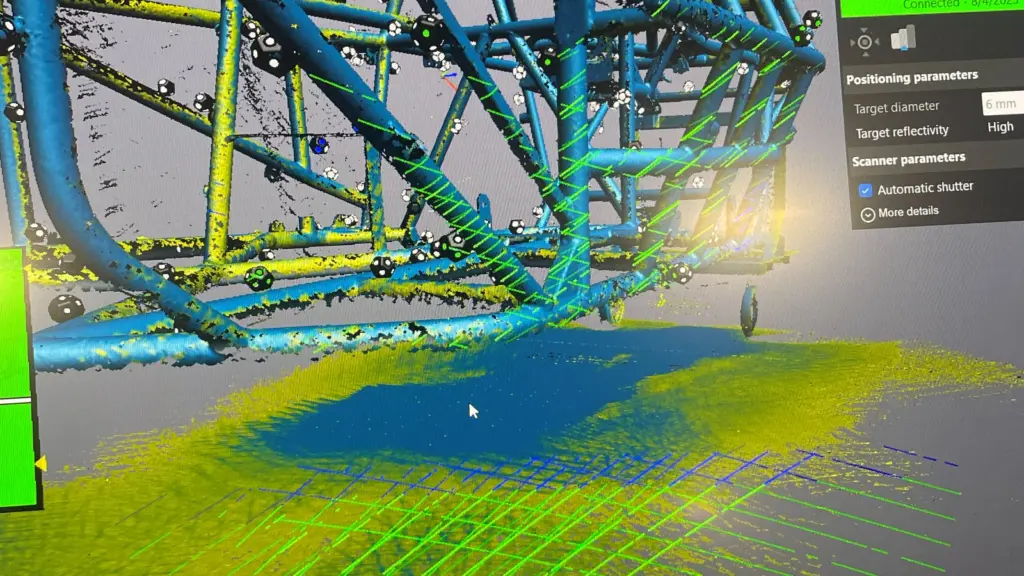
3D scanning captures a physical object as accurate digital data. Parts, assemblies and complete vehicles are measured as they actually are, so anything designed or built afterwards is based on the real thing rather than on an assumption.
The scanner comes to the part. That matters when a component is bolted into something that cannot easily be stripped down, or is simply too large to send anywhere.
A great deal of work starts as an object rather than a drawing. A bracket that was modified years ago, a chassis nobody has a file for, a part that was made once and never written down. Scanning is how those become something a machine can work from.
Capture covers single parts, sub-assemblies, and complete vehicles and chassis. Where a component has to keep working with everything around it, the surrounding area is measured too, so the clearances in the data are the clearances on the vehicle.
Coverage is checked before anyone packs up. A capture that turns out to be short of data is usually only discovered later, by which time the part is back together or the vehicle has gone home.
What you are left with is a dependable record of the object. It is as useful for redesigning a part or replacing one that is no longer available as it is for documenting something that was never drawn in the first place.
3D scanning is the first stage of a chain that carries on in the same building. What comes out of the scan feeds scan to CAD modeling, and the model that comes out of that drives CNC tube bending and notching and sheet metal cutting and forming without being redrawn on the way.
Most of the 3D scanning done here is for motorsports, off-road, SXS and UTV, industrial manufacturing, agriculture and custom fabrication. The industries served page sets out what each of those usually involves.
Work is posted as it leaves the shop on the Infinity Fabrication Instagram, which is the quickest way to see recent jobs. To talk about a part, request a quote and send whatever you already have, whether that is a drawing, a file or a photograph.
What 3D scanning includes
- Mobile and on-site 3D scanning
- Existing parts and sub-assemblies
- Complete vehicles and chassis
- Capture of legacy components with no drawings
How 3D scanning runs
- 01 Scan The part, assembly or vehicle is captured where it sits.
- 02 Check The capture is reviewed for coverage before anyone leaves site.
- 03 Deliver The finished capture is handed over as usable data.
Common questions about 3D scanning
Do I need drawings or a CAD file before you can scan?
No. Scanning exists for exactly the case where nothing has been drawn. A physical part, an assembly or a whole vehicle is enough to start from.
Can you scan a part without removing it from the vehicle?
That is the usual reason the scanner comes to you. Parts that are awkward to strip out, or too large to send anywhere, are captured where they sit.
What happens to the scan afterwards?
It becomes the basis for a CAD model. That modeling is done in the same building, so nothing is exported and reinterpreted by somebody who has never seen the part.
Do you scan complete vehicles or only individual parts?
Both. Single parts, sub-assemblies and complete vehicles and chassis are all captured, along with the surrounding area where clearances matter.